


We hope you’re enjoying the fall season! With the election behind us and markets navigating a challenging stretch, we wanted to share our perspective on recent developments. Before we dive into the market update, we’re excited to pass along a few updates from our team.
The past several months have brought exciting milestones for our team. Jeffrey Hegedus, CFP®’s wife Victoria, gave birth to beautiful twin daughters. Sleep is the new challenge in the Hegedus household! Justin Poccia, ChFC® is a proud first-time homeowner, having purchased a house in Skippack. Dave and his fiancé Tiffany recently completed their long-time goal of visiting all 50 states. North Dakota was their last stop where they enjoyed visiting the Theodore Roosevelt National Park.

Also, this summer we welcomed a new team member, Cole Dorshimer, and opened an office in the western suburbs of Allentown, PA. Then in October, several team members attended the Schwab IMPACT conference to expand their knowledge and bring fresh perspectives to the work we do. We also recently hosted a cybersecurity webinar. If you missed it and would like the recording, please ask and we’ll send it to you.


November 2026 Market Update
Earlier this year, we talked about how strong returns can make it easy to forget what a market decline feels like. The recent volatility has provided a reminder. It is uncomfortable to watch account values fall, especially after several rewarding years. But a difficult week in the market does not, by itself, mean your financial plan needs to change.
What Has Happened in the Market
The recent selling has been particularly sharp in technology and artificial intelligence companies. These businesses helped lead the market higher, so when expectations change, they can also lead it lower. Concerns about the cost of building AI infrastructure, the profits it will eventually produce, and how the election may affect development have given investors plenty to reconsider.
It helps to separate a decline from a recent high from a return for the full year. Through November 6, the S&P 500 was still up about 7.8% for 2026, even after the recent losses. Both statements can be true: stocks have had a difficult stretch, and investors can still be ahead for the year.
We also need to look beyond the largest technology companies. Different parts of the market have behaved differently, and the recent rally in bonds has helped offset some of the recent stock weakness. That is one reason we own a mix of investments. We do not expect every holding to rise together, and we do not want your financial future to depend on one group of companies.
The Economy and the Stock Market
A falling stock market can make it feel as though the economy must be falling apart, too. The latest employment report offers a more balanced picture: employers added 165,000 jobs in October, and unemployment was 4.1%. People working and earning paychecks remain an important support for spending and business activity.
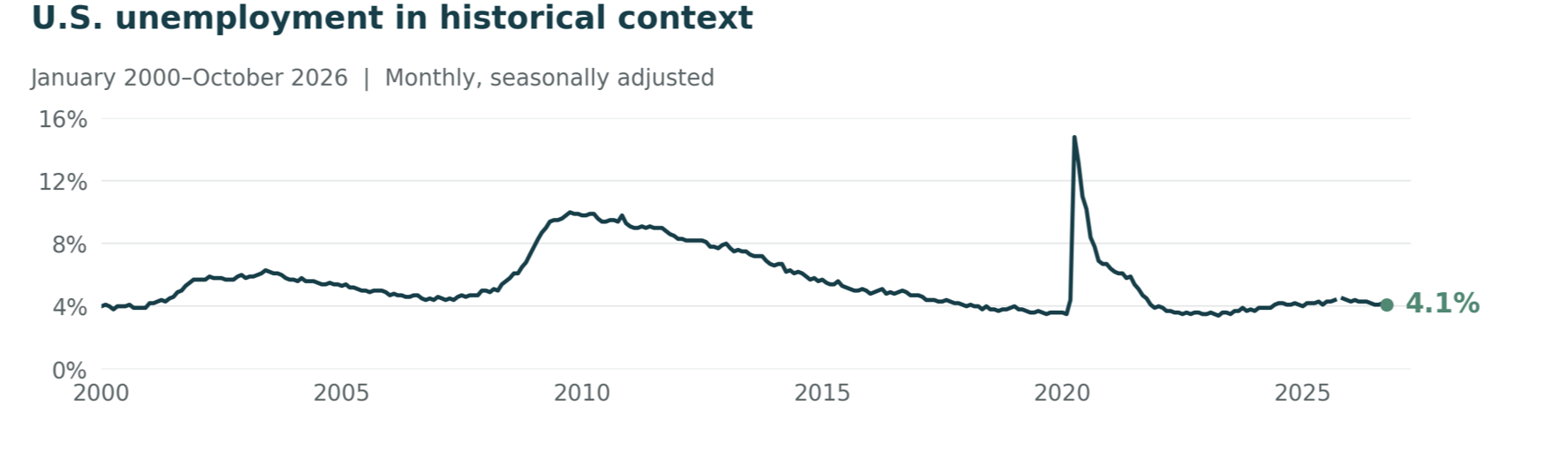
Inflation is still a concern. Consumer prices were 4.2% higher in October than a year earlier, with gasoline contributing heavily to the monthly increase. Higher costs put pressure on family budgets and complicate interest rate decisions. We are watching how these pressures affect consumers and company profits, rather than treating every market move as a verdict on the economy.
What History Tells Us About Midterm Years
Election years can leave investors with strong feelings about what should happen next. Markets, however, do not always follow the script we have in mind. The chart below provides a useful perspective on the months ahead.
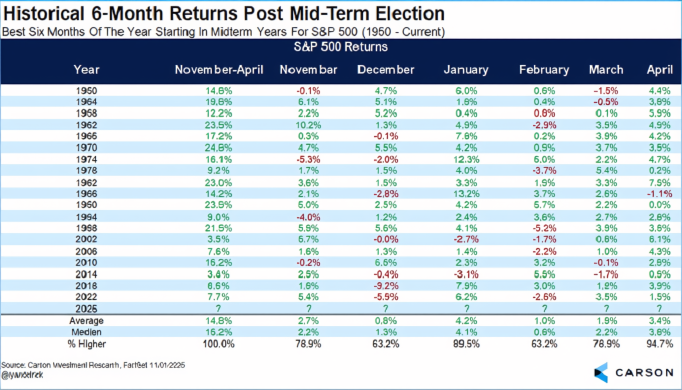
In the 19 completed periods shown, beginning in 1950 and ending with the November 2022 through April 2023 period, the S&P 500 rose every time. The average six-month gain was 14.8%. That is an encouraging historical pattern, particularly when the current headlines feel discouraging.
It is also a small sample covering very different economic environments. It does not mean stocks will rise over the next six months, or that the path will be smooth. Even within these positive six-month periods, individual months were often negative.
We view this as a reason to keep an open mind about what comes next. Selling after a decline can feel like taking control, but it creates another difficult decision: when to get back in. A financial plan should not depend on getting both decisions right.
AI and the Election
Artificial intelligence may change the way many businesses operate. That does not tell us how much investors should pay for an AI company today, or which companies will ultimately benefit most. We can recognize the potential of the technology while being careful about how much of a portfolio depends on its success.
The election adds questions about regulation, energy use, and approvals for new data centers. These issues may affect the pace of development, but proposals and campaign promises still have to become policy. We will follow the changes as they take shape and consider what they mean for the businesses we own.
Why Bonds Still Have a Role
Bonds have had their own challenges as interest rates have moved around. The recent rally is a useful reminder that their role in a portfolio is different from the role of stocks. High-quality bonds can provide income and help balance stock market risk, even though they will not cushion every decline.
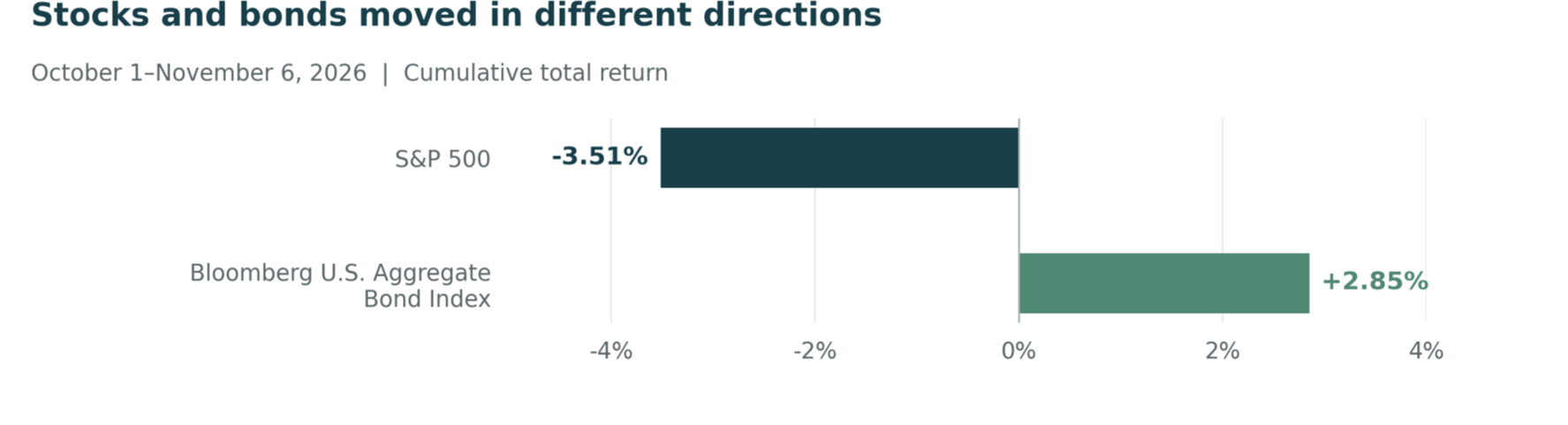
When interest rates fall, existing bonds with higher fixed payments generally become more valuable. When rates rise, those bond prices generally fall. The timing matters: bonds can struggle over one period and provide welcome support over another.
Cash has a different job. Money set aside for near-term spending should be available when you need it. Money intended to support the next 20 or 30 years needs to account for inflation and long-term growth as well. We want each part of your portfolio to have a purpose.
Our Perspective
As we said at the beginning of the year, investment success should be measured by what your money allows you to do. For someone who is retired, that may mean dependable withdrawals and confidence about upcoming expenses. For someone still working, it may mean continuing to save and allowing investments time to grow.
Our job is to keep those goals in view while reviewing the risks and opportunities the market presents. We will continue to monitor developments and make adjustments when they make sense for your plan. A change in your spending needs, retirement timing, or comfort with risk is always worth discussing with us.
If the recent market moves have you concerned, please give us a call. We are happy to walk through your portfolio and revisit how it supports your plans. Thank you for the trust you place in our team.
Warm Regards,
The Milestone Team
Sources: Associated Press, “How major US stock indexes fared Friday 11/6/2026” (S&P 500 price return, excluding dividends); U.S. Bureau of Labor Statistics, October Employment Situation, November 6, 2026, and September CPI, October 14, 2026; Carson Group, “Three Things To Watch Heading Into Midterm Elections,” November 3, 2026. Chart sources: BLS/FRED (UNRATE); YCharts (S&P 500 Total Return); Fidelity Institutional (Bloomberg U.S. Aggregate Bond Index). Market observations are as of November 6, 2026. Figures describe different periods.
This material is for general information and is not individualized investment advice. Investing involves risk, including loss of principal. Past performance does not guarantee future results. Indexes are unmanaged and cannot be invested in directly. Diversification does not assure a profit or prevent loss. Bond prices fluctuate with interest rates and credit conditions. Opinions may change.